What is WIOA funding?
Thinking about training for a new career, such as CNC machining, welding, healthcare or IT, but worried about the cost? A federal program called WIOA may help pay for it.
WIOA (the Workforce Innovation and Opportunity Act) is the main U.S. federal law that funds job training and career services. Signed in 2014, its Title I gives grants to every state for three groups: adults, dislocated workers and youth. States pass the money to local workforce boards, which deliver services through American Job Centers, sometimes called one-stop centers.
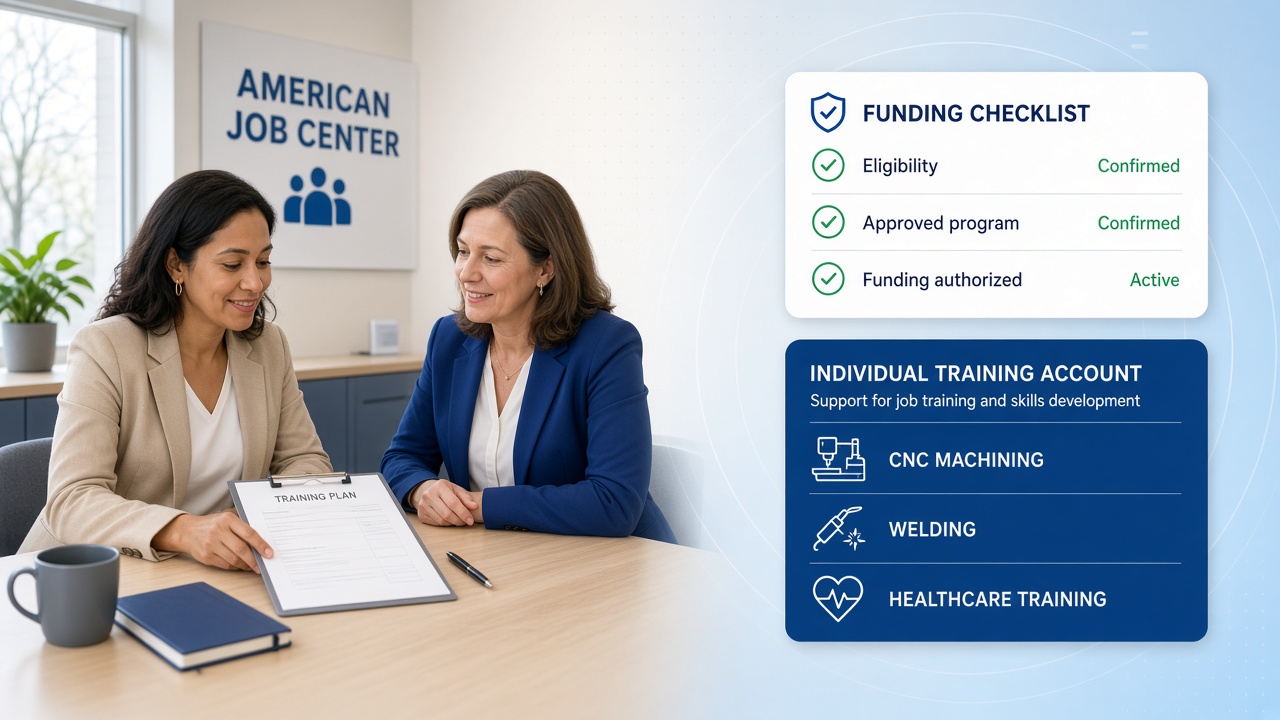
WIOA is not an automatic scholarship. Your local American Job Center has to confirm you're eligible, approve the training program and authorize the funding before you start.
What can WIOA pay for?
WIOA offers two main kinds of help:
- Career services: job search help, career counseling, skills assessments and help building a career plan.
- Training services: paid training for an in-demand job. The most common form is an Individual Training Account (ITA), which is training money the program pays directly to an approved training provider. Depending on your local area, training can also include on-the-job training with an employer, apprenticeships and other work-based learning.
How to Use Your State's Eligible Training Provider List
The training has to be for a job that's in demand in your local area, and it has to come from a program on your state's Eligible Training Provider List (ETPL): the schools and programs the state has approved for WIOA funding. How much each person can get, and which costs are covered, is set by your state and local workforce board, so ask your American Job Center for the exact limits where you live.
Who qualifies for WIOA training funds?
WIOA serves three main groups. Final eligibility is always decided by your local American Job Center.
| Group | Who it covers | Common examples |
|---|---|---|
| Adults | People 18 or older who need training to get a good job | Low-income workers, people receiving public assistance, people with low reading or math skills |
| Dislocated workers | People who lost a job, or got a layoff notice, through no fault of their own | Laid off in a plant closure or mass layoff, self-employed people who lost their business to economic conditions, and displaced homemakers |
| Youth | Out-of-school youth aged 16-24 and in-school youth aged 14-21 who face barriers to work | Young people who left school, are low-income, have low basic skills, are parenting, are in foster care, or have a disability |
Who gets priority?
For the Adult program, American Job Centers must give priority for training to:
- people receiving public assistance,
- other low-income people, and
- people who are basic skills deficient, including English language learners.
This priority applies whether or not money is tight. Veterans and eligible spouses also get priority in every Department of Labor-funded training program.
You may still qualify if...
You don't fit one of the groups above but you face other barriers, such as no high school diploma, limited work history, a disability, homelessness or a criminal record. Ask your American Job Center. Local boards can serve people with barriers to employment, depending on funding.
How to apply for WIOA training funding in 5 steps
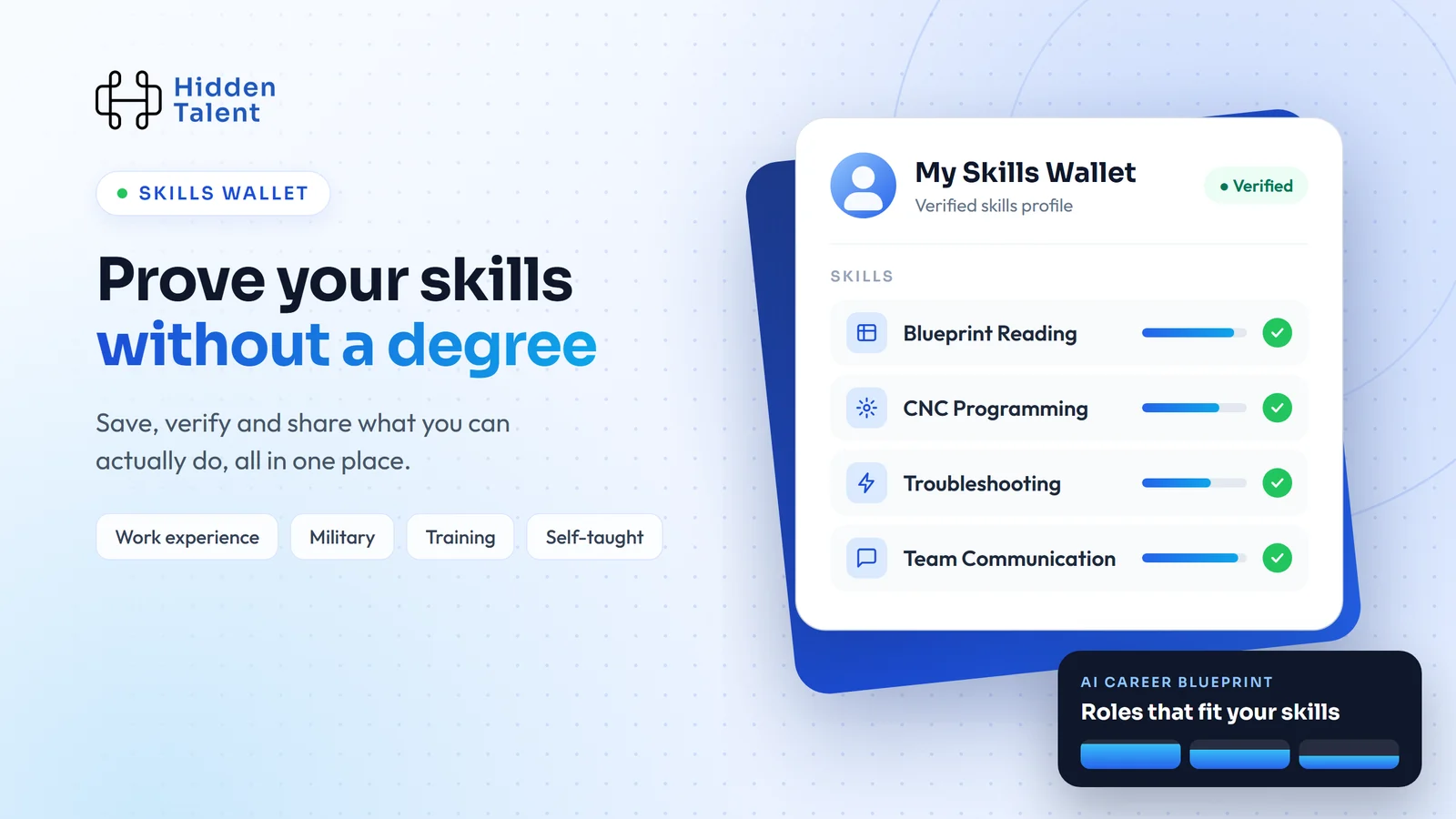
- Know your skills and your goal. Before you meet a counselor, be clear about what you can already do and which job you want. A free Skills Wallet shows your verified skills and the gaps between you and your target role, which makes a strong case for the training you're asking to fund. New to the idea? Read What is a skills wallet?
- Find an approved training program. Search your state's Eligible Training Provider List, or use CareerOneStop's WIOA-Eligible Training Program Finder, which links to every state's list. You can also browse training options on HiddenTalent.
- Contact your local American Job Center. Find the nearest one with CareerOneStop's American Job Center Finder. Ask how to apply for WIOA training services.
- Complete eligibility and an assessment. Expect to show ID, proof that you can work in the U.S., Selective Service registration if it applies to you, and documents that prove your group, such as a layoff notice or proof of income. A counselor will help you build an employment plan.
- Get approval before you enroll. Your counselor approves the program and authorizes the funding. Only then should you sign up with the provider. Paying first and asking for WIOA afterwards usually doesn't work.
Tips to improve your chances
- Pick a job that's in demand locally. WIOA funds training that leads to jobs employers in your area are hiring for. Skilled trades such as CNC machining, welding and industrial maintenance are common examples. See CNC machinist training with WIOA in Ohio.
- Bring proof of your skills. Counselors are matching you to the right training. Showing what you already know can shorten the training you need.
- Ask about extra support. Some areas also help with costs such as transportation or childcare while you train. Ask what's available locally.
- Check your state's rules. Start with our guides to WIOA funding and WIOA in Ohio, or browse all training funding options.
After training: get matched to a job
When you finish, add your new credential to your Skills Wallet and find jobs matched to your skills.
Build Your Free Skills Wallet →
Sources
- U.S. Department of Labor, WIOA Adult program
- U.S. Department of Labor, American Job Centers (help line 1-877-US-2JOBS)
- CareerOneStop, Wonder how public training funds work?
- CareerOneStop, WIOA-Eligible Training Program Finder
- 20 CFR 680.340 (Individual Training Accounts)